

The history of any city is incomplete without accounts of fires. Ottawa, the capital of Canada, was no exception, having experienced numerous devastating fires. Fires have historically altered the true appearance of cities, destroying many historical sites. One of the most notable losses in Ottawa was the first Parliament building, which suffered significant damage. During those years, Ottawa’s firefighting team bravely battled the flames. Many firefighters sacrificed their lives while performing their duties. These were challenging times for the early fire service and its development. Read more on ottawa1.one.
What Ottawa’s Firefighters Were Like in the Past
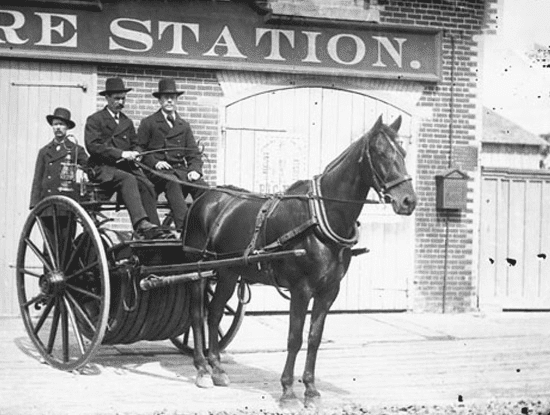
Few Ottawa residents in the 21st century can imagine how firefighters of the past courageously performed their duties. The working conditions for 19th-century firefighters were extremely difficult. They did not even have horses to pull the fire engine. Instead, they had to manually haul the fire apparatus to the scene of a blaze. Additionally, Ottawa’s firefighters were originally a volunteer organization rather than an official municipal unit.
The first horses for Ottawa firefighters appeared only in 1874, when the city purchased a new steam-powered fire engine for an enormous sum of approximately $6,000. The new steam apparatus was so heavy that it could no longer be moved manually, making horses essential for fire operations. The Ottawa authorities had no choice but to acquire horses for their fire department. Depending on weather conditions, three to six horses were required to pull the fire engine to the fire site.
Additionally, in 1874, Ottawa officially registered its first professional fire department.
The First Motorized Fire Engines in Ottawa
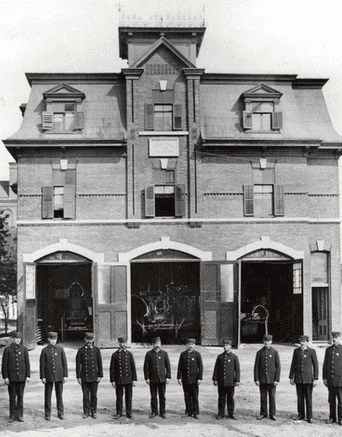
At the beginning of the 20th century, motorized fire engines replaced horse-drawn fire apparatus.
Motorized vehicles quickly gained popularity among Canadian fire departments. The new engines were faster, cheaper, and easier to maintain. In contrast, maintaining horses required daily feeding, grooming, stabling, shoeing, harnessing, and frequent veterinary checkups. Moreover, horses needed constant training to ensure they remained responsive in emergencies.
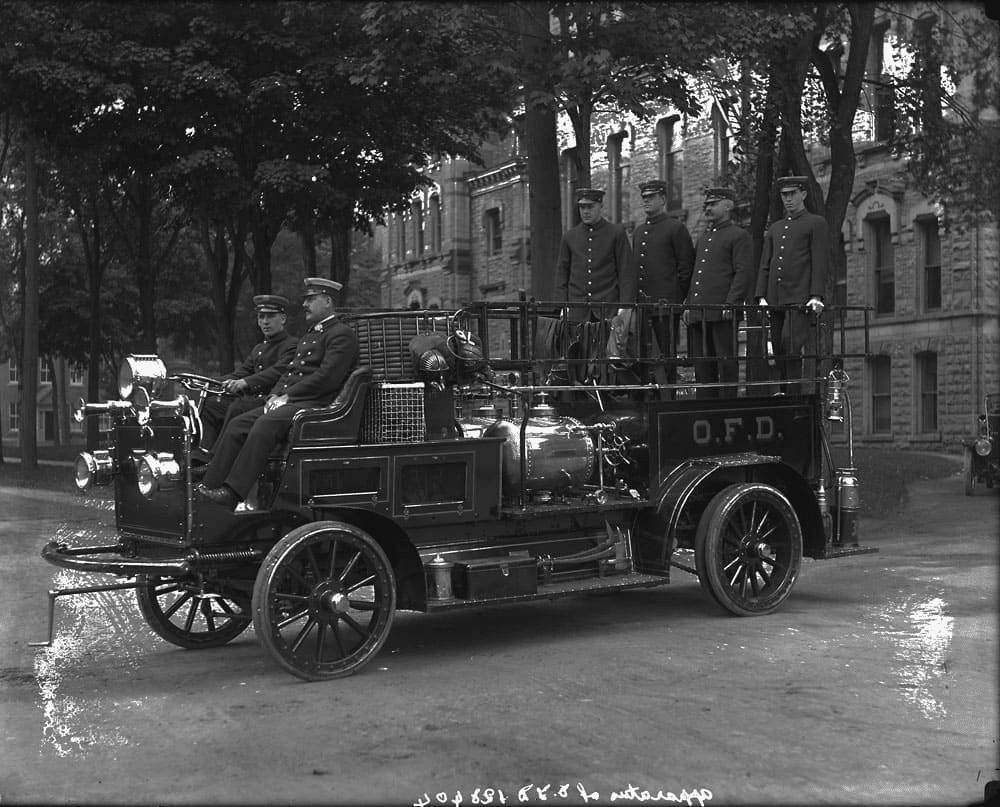
Ottawa’s first motorized fire engine appeared in 1911. From that moment on, firefighting operations became significantly faster, more efficient, and more effective. Over the span of 70 years, Ottawa’s fire service had undergone a dramatic transformation.
The last use of a horse-drawn fire engine in Ottawa occurred in 1928 during a fire at the old Russell Hotel. By the end of 1928, Ottawa’s fire department had fully transitioned to motorized vehicles.
In the 21st century, Ottawa’s fire service has expanded into a modern operation with 45 fire stations, each equipped with its own depot. Ottawa firefighters now protect nearly a million residents across an area of more than 2,000 square kilometers. The fire department possesses pumpers, ladder trucks, emergency and rescue vehicles, brush fire trucks, boats, all-terrain vehicles, and a wide range of specialized firefighting equipment.
The Legacy of Ottawa’s Firefighters
Concerned Ottawa residents in the 1980s decided to preserve the history of the fire service by establishing a non-profit historical organization known as the “Bytown Fire Brigade.” This organization is dedicated to acquiring, restoring, and displaying various firefighting equipment and artifacts that chronicle the development of Ottawa’s fire service. The Bytown Fire Brigade holds the largest collection of antique firefighting equipment in Canada. Anyone interested in learning more about Ottawa’s firefighting history can visit the museum to explore this fascinating legacy.