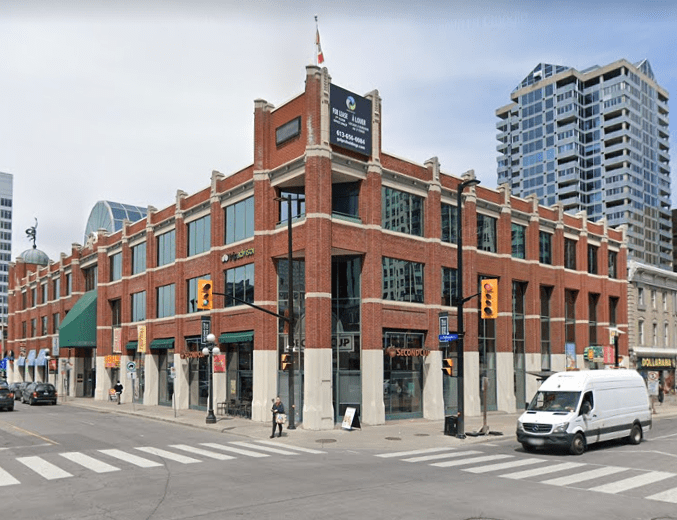
The mid-20th century was a time of great change and challenges for Ottawa’s department stores. Many long-standing stores and retail chains began to close, making way for new, modern shopping complexes. Ottawa lost numerous iconic businesses that had thrived as family-run establishments, many of which were located in the city’s historic downtown.
One such store was Larocque, a department store that had provided high-quality goods and excellent service to Ottawa’s Francophone community for many years. Ottawa One explores the history of this once-beloved store.
Opening of the Store
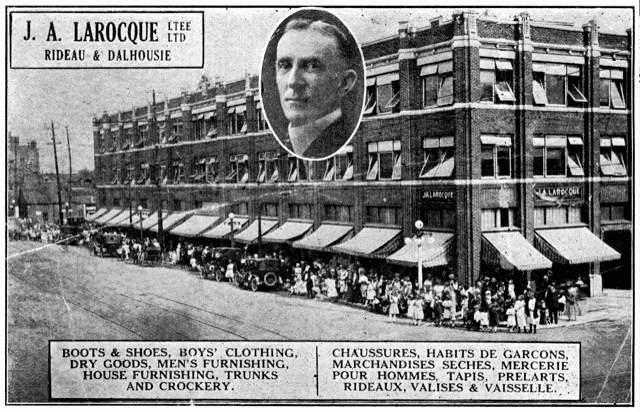
The Larocque store first opened in 1909 in the heart of Ottawa, on Dalhousie Street. It was founded by a local resident, Joseph Larocque. The store was relatively small, occupying just a few hundred square meters. However, it quickly gained immense popularity among Ottawa’s Francophone population from the very first days of its opening. It specialized in haberdashery and accessories.
Due to the rapid success of the business and the growing demand for Larocque’s products, Joseph Larocque was able to purchase the shares of a neighboring store in 1911, expanding his business significantly.
What Was Sold at Larocque?
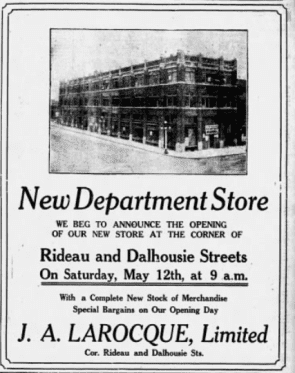
In 1913, Larocque was advertised for the first time in the Francophone newspaper Le Droit. The ad featured a variety of products, including hats, feathers, Japanese silk, and much more. The newspaper also highlighted the store’s reputation for offering high-quality goods at very competitive prices.
Beyond its affordable prices and unique products, Larocque held an exclusive distinction—it was the only distributor in Ottawa for the popular D&A corsets of the early 20th century. Customers could always find the latest fashion items in stock, available in all sizes. Joseph Larocque built his business success on the consistent quality of his products.
Business Success and Expansion
By the 1920s, Larocque had achieved remarkable success. The store had reached a point where it could become part of Ottawa’s growing network of department stores. Joseph Larocque, recognizing this opportunity, began actively purchasing land plots near his store on Dalhousie Street to build a larger department store.
The final plot he acquired was a vacant lot owned by the city, previously used for the expansion of Dalhousie Street. He purchased this land from the Ottawa municipal government for $60,000.
Construction of the Department Store
The construction of the new Larocque department store in the 1920s was not without financial difficulties. The costs of acquiring land had been substantial, and Larocque was forced to reduce his existing retail space by half due to high rental expenses. He also had to sell off large portions of his remaining inventory at discounted prices.
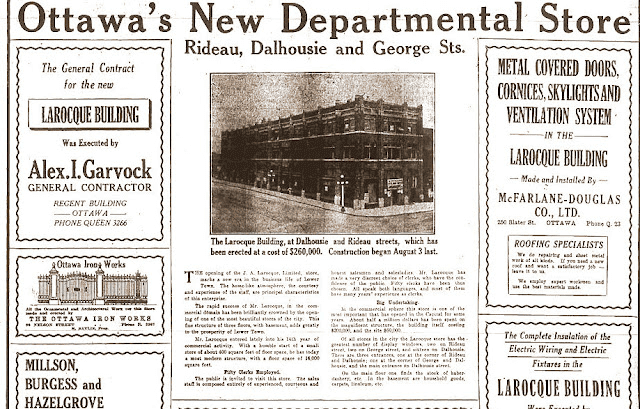
Despite these challenges, construction on the Larocque department store began in 1922. The project was expected to be completed within a year. The building was designed by three renowned Canadian architects, with Harvock serving as the general contractor.
The department store was a three-story building located at the corner of Dalhousie Street. It became Ottawa’s only department store with the highest number of display windows. Additionally, it featured three separate entrances: the main entrance on Dalhousie Street and two others on Bank Street and St. Patrick Street. Streetcars stopped directly in front of these entrances, making the store highly accessible.
Inside Larocque, a warm and welcoming atmosphere awaited customers. The staff was highly experienced and provided service in both English and French.
The total cost of constructing Larocque in the 1920s, including land acquisitions and stock purchases, amounted to approximately $500,000—a monumental sum for that era.
Decline of the Store
Despite Larocque’s status as one of Ottawa’s finest department stores, the business did not generate the same level of profit as before. One of the store’s critical missteps in the 1920s and 1930s was its lack of advertising. While competing businesses heavily invested in newspaper and magazine advertisements, Larocque relied solely on in-store promotions and discounts. This was not enough to compete with stronger, better-marketed businesses.
As a result, Larocque went bankrupt in 1926.
After the bankruptcy, the store was purchased by Wineberg & Goodman, a major retail company that owned a network of department stores across Nova Scotia.
Larocque Registered
The new owners slightly modified the store’s name, rebranding it as Larocque Registered, preserving part of the original name to maintain its historical significance.
Despite the change in ownership, the store’s core values and policies remained unchanged. It continued to primarily serve Ottawa’s Francophone community, maintaining its bilingual service.
In 1931, the two business partners of Wineberg & Goodman parted ways. The Wineberg family acquired full ownership of Larocque Registered, and Joseph Wineberg became the store’s manager.
Larocque Store Number Two
In 1933, the original owner of Larocque, Alphonse Larocque, decided to try his luck again. He opened another department store, J.A. Larocque, on the same Dalhousie Street, not far from Larocque Registered.
For a time, two Larocque stores operated directly across from one another.
Unfortunately, J.A. Larocque could not withstand the competition and went bankrupt again in 1934. The Wineberg family acquired all the shares of the failing company.
The Success and Closure of Larocque Registered
Under Wineberg’s management, Larocque Registered flourished for several decades. The store maintained its reputation for excellent customer service and bilingual assistance, continuing to cater primarily to Francophone Ottawans.
In 1947, Joseph Wineberg passed control of the business to his sons. After successfully managing the store for many years, he passed away in 1967.
By the early 1970s, Larocque faced insurmountable challenges. For the Francophone population of Ottawa and the store’s employees, its closure was a shocking development, given its long-standing success.
The emergence of large shopping malls, boutiques, and retail chains in Ottawa during the 1970s made it increasingly difficult for Larocque Registered to compete. The store was too small to rival major department stores yet too large to compete with niche boutiques.
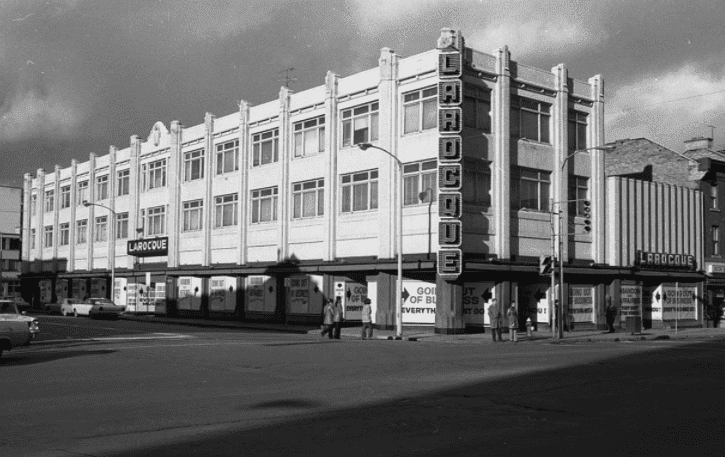
As a result, Larocque Registered permanently closed in the early 1970s.
In 1972, a temporary department store named Kaplan moved into the former Larocque building. Kaplan’s main store was located on Rideau Street.
Between 1989 and 1993, the former Larocque building underwent renovations. Today, in the 21st century, the building belongs to a different company.